
Why the Internet is breaking
The Great Hardening
Nobody is attacking us. New models are finding old bugs faster than ever, we are patching them, and patching means touching systems nobody has touched in a decade. Some of them break. Then we fix that too.
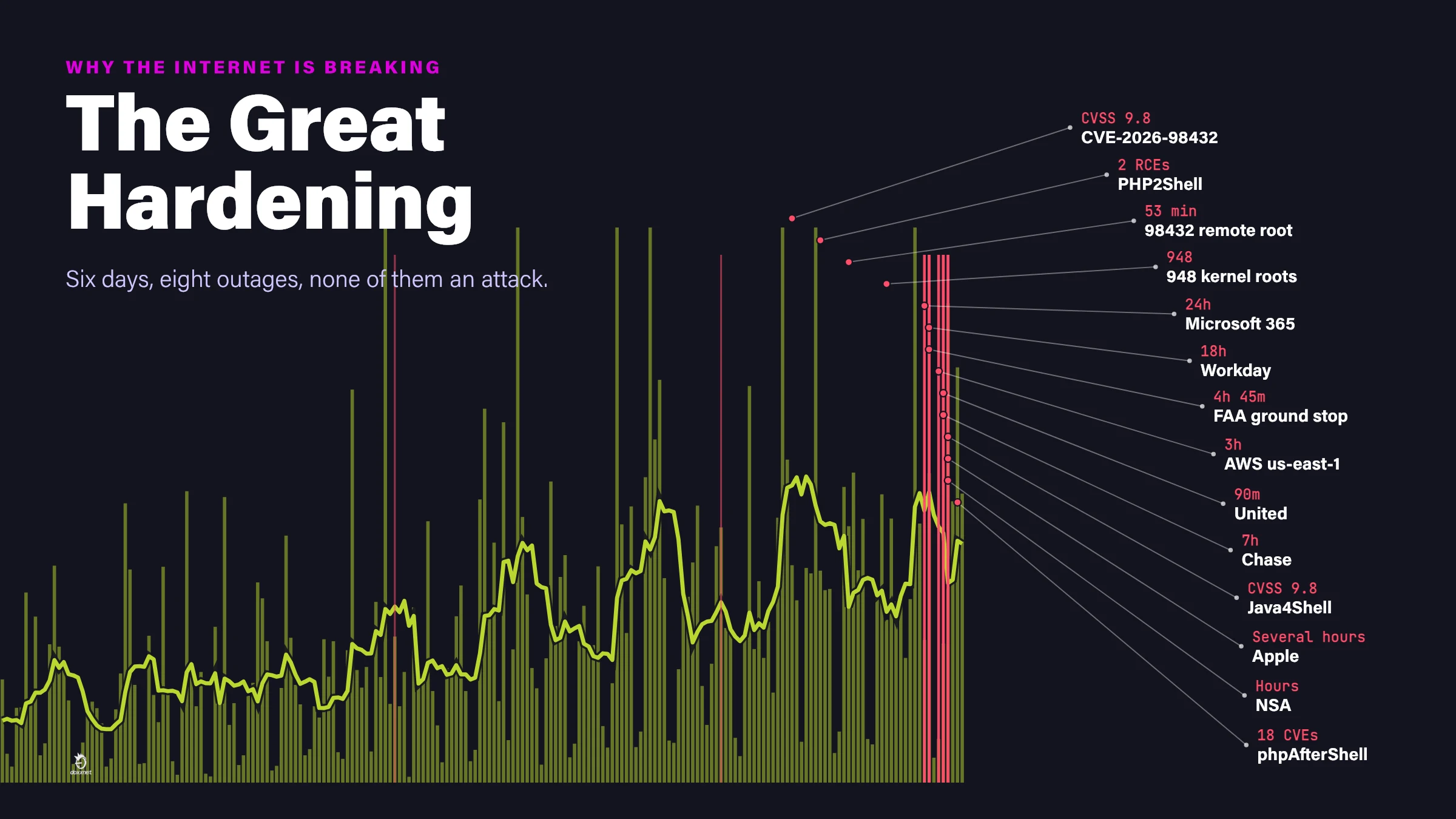
It looks like a war. It is a renovation. AI found ten years of bugs in one year, the fixes all require a restart, and the machines with the longest uptimes are the ones that fall over when you finally touch them. Loud, messy, and temporary.
My phone has been going off for a week. Friends and family are all asking me basically the same question: is Iran hacking everything?
I understand their worry. Last week, on Thursday, Microsoft 365 went down for almost 24 hours. The next day the FAA stopped every departure in the country. On Monday a bug at Chase affected multiple banks, and United grounded airplanes. On Tuesday the NSA's classified internal network went down. If you do not work in this field, "someone is attacking us" feels right.
But I don't believe that's the case. Every one of those organizations said the same thing, and I believe them. "This was not a cyber attack." The real story is less dramatic but, if you run infrastructure for a living, more worrying. We touched things, and they could not take it.
That is a claim, so I went and pulled the data. Three things, on one timeline: every CVE published since the start of 2019, every frontier model release from GPT-2 to this month, and every major outage that a company blamed on its own software or its own maintenance.
A CVE is a publicly registered software flaw, a Common Vulnerabilities and Exposures record, one numbered entry per bug in a database the whole industry shares. When a researcher finds a hole in Linux, or Java, or a Cisco router, it gets a CVE number, a severity score from 0 to 10, and a fix that someone, somewhere, now has to install. The count of CVEs published per day is the closest thing we have to a speedometer for how fast the world is finding the bugs that were already there. Here is what it looks like.
The chart is live: hover any day for what happened, switch the range, or expand it. Green bars are CVEs published per day, from the NVD. The green curve is the smoothed rate. Red lines are major public outages caused by software or by touching a system; none were attributed to an attack. The dashed red curve is the outage rate per month, on the right axis. Purple ticks on the date axis are generation-defining model releases, connected to their lab below. Power, weather, war and plain config-slip outages are excluded.
Read it left to right. From 2019 through 2023 the industry published between 50 and 85 CVEs a day, and it grew a little each year. GPT-3 and ChatGPT did not move it. 2024 reached 110 a day and 2025 about 140, a major outage of this kind every month or two. Then in 2026 the green curve bends: 200 a day in March, 400 in August, more than 600 a day in November. The purple ticks under the axis are the model releases that changed what the technology could do. The red lines are the outages. They crowd the right edge, where the curve is steepest and the releases are densest. Last week's five sit on top of each other.
| 2025 | November 2026 | |
|---|---|---|
| Average CVEs published per day | 137 | 620 |
| Major outages per 10,000 CVEs | 1.0 (and every year since 2019) | 6.5 (Nov 12 to 17) |
What actually broke
You have to fix all your old stuff that has not been rebooted in years, and it does not always come back the way you expect.
Barrett Lyon
Founder, doxx.net

The FAA was replacing copper with fiber at a radio site and installed a new router. It started broadcasting into the air traffic network at about 1,000 connection attempts every few seconds, and in the FAA's own words, "legacy equipment became unstable."
I do not know what was driving the schedule. But that cutover happened at 3:30 on a Friday afternoon, in the busiest travel window of the week, on a program that had already put more than 60 of these routers into the network. Nobody touches the core of the air traffic system mid-day unless something is pushing them: a deadline, an exposure they were racing to close, or both. And that is the sad part. This should have been boring. A network that swaps a router every week knows exactly what a new router does when it comes up. One that does it in a hurry, years apart, finds out live, with 3,500 airplanes in the air.
Microsoft shipped a bug to its cloud gateway in July. It sat dormant until a routine traffic failover in November woke it, and 80% of the gateway fleet froze. It never fired in testing because the test machines had fewer CPU cores than production. Restarting did nothing, because the backlog hit the servers on the way up and froze them again.
Chase reported "a software bug in on-premise hardware systems." The NSA said it was a "temporary degradation during scheduled routine maintenance." This was all routine maintenance. In a group chat this week I said, "You have to fix all your old stuff that has not been rebooted in years, and it does not always come back the way you expect."
Who is breaking first
Look at who is on the chart. For seven years the red lines belonged to the hyperscalers and the networks: Cloudflare, AWS, Azure, Google, Fastly, Facebook. That is partly because they publish post-mortems and a bank does not. But it is also because they touch their systems constantly, so they pay the change tax in small, public pieces. Last week the lines belonged to institutions: the FAA, a bank, an airline, an HR platform, an intelligence agency. These are the 1,400-day systems: the mainframe jobs, the control planes, the appliances and the clusters nobody has drained in years. The patchpocalypse took away their option of not touching, and they did in one week the kind of change the hyperscalers do every day, on systems that had never done it.
They were American first for boring reasons. CISA gives federal agencies hard patch deadlines, and "scheduled routine maintenance" is what a deadline looks like from the inside. Bank and aviation regulators have their own clocks. The disclosures came from American labs and vendors, so American customers were first in line for the fixes. And an American outage is on the news within the hour.
The institutions that patch on a schedule break first and harden first. The ones that do not will show up later, some of them as breaches instead of outages. Same bill, paid two ways.
So read the right edge of the chart as a leading indicator, not a local problem. The institutions that patch on a schedule break first and harden first. The ones that do not will show up later, and some of them will show up as breaches instead of outages. It is the same bill, paid two ways.
One more thing last week had in common: every institutional failure was a dependency that everything else hung off. An identity gateway. The FAA's network. Weight and balance. NSANet. Hyperscaler outages are usually regional. Institutional ones are total, because nothing was built to be partially up.
The decade nobody touched it
People are used to the internet working. But when we were building it in the early 2000s, it fell apart constantly, in front of people who knew how to fix it. Then for like ten years we built on top of the plumbing instead of into it and prized uptime above everything else. When a system has been up for 1,400 days, nobody remembers what it does when it starts, or what it needs to already be running. We traded frequent small failures for rare, massive ones.
Why now?
The 'patchpocalypse' has begun. In October a Linux kernel bug, CVE-2026-98432, got a 9.8: unauthenticated remote root through the TCP handshake, in the kernel since 2016, with the exploit written by an AI model in 53 minutes. The only fix is a new kernel and a reboot. Then in November, a second one dropped: Java4Shell, a heap overflow in Java's Base64 decoder, reachable before login through standard auth libraries, and it only exists on newer CPUs with AVX-512. Oracle patched it, but the mitigation requires a restart. PHP, which runs most of the web, has had two of these in a month: PHP2Shell in October, two decade-old bugs in the core engine found with Gemini and GPT, and yesterday eighteen more fixes in a single release, seven of them critical, one of them found by a frontier model.
This is a cadence, not a coincidence. Every frontier model release is a new scanner pointed at the entire installed base. The kernel was always this buggy, we just couldn't see it. And to be clear about what the chart shows: this is not AI models hacking people or companies. It is responsible companies finding flaws with new technology and fixing them before something bad happens.
The numbers say the same thing. Each of this year's big releases showed up in the CVE feed a month or two later. October set the record with 17,481 CVEs published, and the busiest single day was October 13 with 2,308. The year to date is 104,709, more than double all of 2025, with six weeks to go.
| Release | Date | Then the CVE feed |
|---|---|---|
| Claude Opus 4.6 | Feb 5 | March +31% |
| Claude Mythos Preview | Apr 7 | May +19%, June +15% |
| GPT-5.6 | Jul 9 | August +28% |
| GPT-6 Astra | Sep 3 | October +16% |
| Gemini 4 Carbon, GPT-6 Cyber, Fable and Mythos 5.2, GPT-6.2, Gemini 4 Neon | Oct 28 to Nov 18 | December to February |
The attackers have changed. Nation-states have these models, and so does everyone else. AWS documented a low-skill actor with no state ties who used commercial AI to compromise more than 600 FortiGate firewalls and pull complete credential databases. The script kiddie who used to copy a tool now describes what they want and gets a campaign. They still cannot adapt when the plan fails, and just move on when they hit resistance. But their first attempt is now as good as a junior pentester's, and there are millions of them.
At the other end of that spectrum is North Korea. On October 29 its TraderTraitor unit took $6.3 billion out of Binance in about twenty minutes, the largest theft in the history of the asset class and four times the Bybit heist of last year. No cryptography broke. The way in was a tampered installer from a malicious ad in June, a fake job interview in September, and in October Binance's own internal AI tool as the springboard into the wallet-signing service. It is the state-level version of the same story: the failure lives in the operational layer that decides what gets signed, and the attackers now have better tooling for finding that layer than most defenders have for fixing it. It is also the exception in two weeks of headlines. It was the one thing that actually was an attack, and it was not Iran.
| Theft | Date | Amount |
|---|---|---|
| Binance | Oct 29, 2026 | $6.34 billion |
| Bybit | Feb 2025 | $1.5 billion |
| Ronin | Mar 2022 | $625 million |
| Poly Network | Aug 2021 | $611 million |
| Coincheck | Jan 2018 | $534 million |
We are building more than ever. A single 8-GPU B300 server ships with eight 800-gigabit ports, 6.4 terabits out of one box. New gear is going into old networks at the fastest rate since the fiber boom, and new gear into old networks took down the FAA.
The choice that used to be easy
This is not AI models hacking people or companies. It is responsible companies finding flaws with new technology and fixing them before something bad happens.
For ten years the safe answer to "should we reboot it" was no. Today the choice is to either leave it exposed to remote root, or restart the system that has been running for four years, which nobody fully understands. Neither is safe. The people who take the first bet will lose it publicly. We just saw what happened to those who did the latter. And this will happen with every model release. So, honestly, things will be unstable for a while.
How unstable? There is a ratio hiding in the data. Since 2019 the industry has had about one major software or maintenance outage for every 10,000 CVEs it published, and that held every single year, through the pandemic, through Log4Shell, through CrowdStrike. Last week it ran at six and a half. Between October 28 and November 18 four frontier models shipped, the densest release window there has ever been, and every earlier release of that class showed up in the CVE feed 30 to 60 days later. If the ratio holds and the growth holds, this is what the next year looks like.
How it is built. CVE growth is the log-linear fit to the ten full months of 2026: 15.8% per month, doubling every 4.7 months. High: that rate holds all year, which is what "every model release is a new scanner" implies if nothing else changes. Base: it holds through the disclosure window of the late-October cluster, then decays 20% a month as CNA and triage capacity bind, the bottleneck Anthropic itself named. Low: growth decays from day one. Outages are CVEs times a crash ratio: the record has run at 1.0 major software or maintenance outage per 10,000 CVEs every year since 2019, the last quarter ran at 2.0, and November alone at 6.5. Under the base case that is about 33,000 CVEs in March 2027, over 1,000 a day, and six or seven major outages a month, against a 2019 to 2025 norm of one every four months. This is an extrapolation of a curated outage list, not a forecast.
What to do
Restart on purpose before you are forced to. Know what every system does when it comes back, not just the hosts but the clusters, the control planes, the service meshes, the jobs that only run at startup and the dependencies they assume are already up. Test on production-shaped hardware. Turn off what you do not use. Verify isolation instead of assuming it. Treat model releases as patch events and put the window on the calendar before the CVEs land. Be the target the AI-augmented attacker moves on from. And for everyone who called me this week: keep a local copy of what you cannot lose, and have a second way to reach the people you need to reach.
Don't Panic: Let the pros fix things
People are building again. Every incident this week produced a fix within days. On the other side of this is an internet that has been rebooted on purpose, by people who were watching.
I have been calling this phase the Great Hardening. The patchpocalypse will shake things loose, and we will fix them as they break. It will be painful and supremely messy, but at the other end of this we will have a better digital infrastructure because of it.
The point is bigger than us. People are building again. Every incident this week produced a fix within days. The bugs being found are bugs that were always there. On the other side of this is an internet that has been rebooted on purpose, by people who were watching.
If you would rather skip the hard way
If you want to avoid a lot of this, look at what we built. doxx.net is the most advanced private networking and privacy platform available to consumers anywhere, and it was built to be touched: when CVE-2026-98432 dropped we wrote a filter into our own servers and had every customer covered before Ubuntu had a kernel out. Get started at doxx.net, point your agent at config.doxx.netOpens in a new tab, or join the community at doxx.net/discordOpens in a new tab.
Sources: NVD CVE API 2.0 by published date, pulled November 20, 2026; lab release pages and themodelindex.org; the Epoch Capabilities Index for the generation cutoff; provider post-mortems via the controlplane.com outage tracker; the FAA ground-stop Q&A; the Cloud Security Alliance note on the November 12 to 17 cluster; OpenAI, Anthropic, Akamai, Oracle, Binance, Chainalysis and TRM Labs disclosures.

Barrett Lyon
Founder, doxx.net